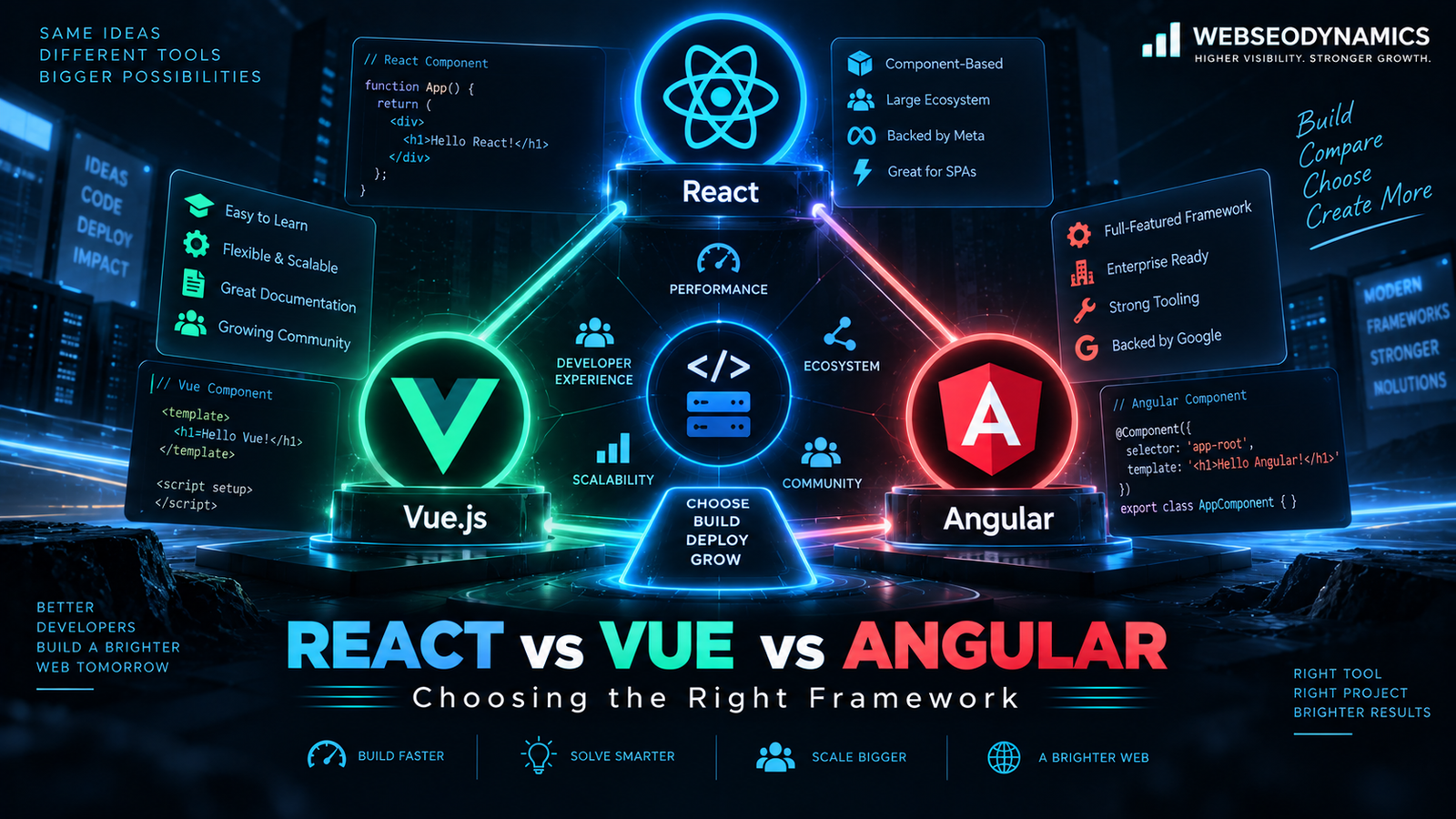
React vs Vue vs Angular: Choosing the Right Framework for Your Next Project
Ask ten developers which frontend framework is "best" and you'll get ten confident, contradictory answers — and most of them will be defending whichever one they already know well. The honest reality is that React, Vue, and Angular are all mature, capable, production-proven tools used by some of the largest applications on the web. The right choice depends far more on your team, your project's specific requirements, and your long-term maintenance plans than on any single benchmark or trend.
This guide sets aside the tribal framework debates and focuses on the practical differences that should actually inform your decision: learning curve, architecture philosophy, performance characteristics, ecosystem maturity, and the kinds of projects each framework tends to suit best.
1. The Three Frameworks at a Glance
Before comparing details, it helps to understand what category each tool actually belongs to — they're not as interchangeable as "pick a frontend framework" makes them sound.
React
A UI library maintained by Meta, focused narrowly on building components. Routing, state management, and other application concerns are handled by separate libraries you choose yourself.
Vue
A progressive framework that can be adopted incrementally — usable for a single interactive widget on a page, or scaled up into a full single-page application with its official router and state management libraries.
Angular
A complete, opinionated platform maintained by Google, bundling routing, forms, HTTP client, dependency injection, and testing tools together in one cohesive framework, built around TypeScript from the ground up.
2. React: The Flexible Library
React's defining characteristic is that it's deliberately unopinionated about everything outside of rendering components. It gives you JSX for describing UI, a component model, and hooks for managing state and side effects — and leaves routing, global state management, form handling, and data fetching entirely up to you and the ecosystem of third-party libraries built around it.
function Counter() {
  const [count, setCount] = useState(0);

  return (
    <button onClick={() => setCount(count + 1)}>
      Clicked {count} times
    </button>
  );
}
This flexibility is React's biggest strength and its most common criticism at the same time. It means teams can assemble exactly the tools they need, but it also means two React codebases built by different teams can look wildly different from each other — one might use Redux, another Zustand, another just built-in Context; one might use React Router, another a meta-framework's built-in router entirely. This flexibility can lead to decision fatigue for teams without established conventions, especially on new projects.
3. Vue: The Approachable Progressive Framework
Vue sits deliberately between React's minimalism and Angular's completeness. Its template syntax stays close to standard HTML, which many developers — especially those coming from plain HTML/CSS/JS rather than another framework — find more approachable to read and write than JSX at first.
<template>
  <button @click="count++">Clicked {{ count }} times</button>
</template>

<script setup>
import { ref } from 'vue';
const count = ref(0);
</script>
Vue is called "progressive" because it can be adopted incrementally — dropped into a single page of an existing traditional site to add interactivity to one widget, or scaled up into a full application using its official companion libraries (Vue Router, Pinia for state management), which gives teams an official, cohesive path without React's need to evaluate and choose between competing third-party options for every application concern.
4. Angular: The Complete, Opinionated Platform
Angular takes the opposite approach from React entirely: it's a full platform with strong opinions about how applications should be structured, built around TypeScript as a first-class citizen rather than an optional addition. Dependency injection, a powerful CLI for scaffolding and building projects, a built-in HTTP client, form handling (both template-driven and reactive), and routing all ship as part of the core framework.
@Component({
  selector: 'app-counter',
  template: `<button (click)="increment()">Clicked {{ count }} times</button>`
})
export class CounterComponent {
  count = 0;
  increment() {
    this.count++;
  }
}
This completeness makes Angular a strong fit for large teams and enterprise environments where consistency across many developers and codebases matters more than individual flexibility — everyone on an Angular team is more likely to structure their code similarly, since the framework provides fewer degrees of freedom for divergent conventions to emerge in the first place.
5. Learning Curve Compared
Vue is generally considered the gentlest entry point, particularly for developers already comfortable with HTML, CSS, and basic JavaScript, since its template syntax and official documentation are widely praised for approachability. React's core concepts (components, props, hooks) are also relatively simple to pick up initially, but the surrounding ecosystem decisions — which router, which state management approach, which meta-framework — add a layer of complexity that beginners often find confusing precisely because React itself doesn't prescribe an answer.
Angular has the steepest initial learning curve of the three. TypeScript, dependency injection, RxJS (reactive programming with observables, used heavily throughout Angular), and the framework's more extensive API surface mean new developers typically need longer to become productive — but that investment pays off in more consistent, predictable codebases once the team is past the initial learning period.
6. Performance Compared
In modern versions, all three frameworks perform well for the overwhelming majority of real-world applications, and raw framework benchmark differences rarely matter as much as how well an application is actually built on top of whichever framework is chosen. That said, some architectural differences are worth understanding:
- Vue's reactivity system tracks dependencies at a fine-grained level, often requiring less manual optimization to avoid unnecessary re-renders compared to React's model, where developers sometimes need to reach for memoization to prevent components from re-rendering more than necessary.
- React's rendering model has evolved considerably, with concurrent rendering features letting the framework prioritize urgent updates over less critical ones, improving perceived responsiveness in complex applications.
- Angular's change detection historically checked the entire component tree by default, which could be slower for very large applications, though newer versions have introduced more granular, signal-based reactivity that significantly narrows this gap with the other two frameworks.
- Bundle size tends to favor Vue and React for small to mid-sized applications, since Angular's more complete feature set generally produces a larger baseline bundle — though this difference matters much less once an application grows large enough that the core framework size is a small fraction of the total bundle.
7. Ecosystem and Hiring
React has the largest ecosystem and job market of the three by a significant margin, meaning the widest selection of third-party libraries, community resources, and available developers to hire. This scale is a genuine practical advantage for many businesses, independent of any technical merits — finding React developers and pre-built solutions for common problems is generally easier than for Vue or Angular.
Vue has a smaller but dedicated community and ecosystem, historically stronger in parts of Asia and among smaller teams and independent developers, with somewhat fewer third-party libraries to choose from but correspondingly less decision fatigue since Vue's official libraries cover most common needs directly.
Angular has a smaller talent pool than React but remains heavily used in enterprise and large organizational contexts, particularly where the surrounding company already has a strong existing investment in TypeScript and a preference for standardized, prescriptive tooling across many teams.
Testing and Tooling
Angular ships with a built-in testing setup (historically Karma and Jasmine, with newer projects increasingly defaulting to alternatives like Jest or Web Test Runner), meaning a new project starts with a working test configuration out of the box. React and Vue projects typically require choosing and configuring a testing library separately — commonly Vitest or Jest paired with Testing Library — which offers more flexibility in tooling choice but means testing setup isn't as immediately standardized across different teams' React or Vue projects the way it tends to be across Angular projects.
8. Which One Should You Choose?
- Choose React if you want the largest hiring pool and ecosystem, you're comfortable making your own architectural decisions (or using a meta-framework like Next.js that makes many of them for you), or your team already has React experience.
- Choose Vue if you want the gentlest learning curve for a team newer to modern frontend frameworks, you value an official, cohesive set of tools without needing to evaluate competing third-party libraries, or you're incrementally adding interactivity to an existing traditional site.
- Choose Angular if you're building a large enterprise application maintained by many developers over a long timeline, your organization already standardizes on TypeScript, or you want a framework that enforces consistent structure and conventions across teams by default rather than by discipline alone.
It's also worth acknowledging that switching costs are real. Migrating a mature application from one framework to another is a significant undertaking, rarely justified purely by a framework's technical merits alone. If your team already has deep expertise in one of these three and the application is working well, "we should rewrite in a different framework" needs a much stronger justification than a preference for newer syntax or marginally better benchmark numbers.
A full rewrite also carries hidden costs beyond the engineering hours themselves: feature development typically slows or pauses during the transition, subtle behavioral differences between the old and new implementation can introduce regressions that take months to surface, and the team loses the accumulated institutional knowledge embedded in the existing codebase's edge-case handling. Where a genuine framework change is warranted — say, an aging Angular.js (not to be confused with modern Angular) application that's become difficult to hire for — an incremental migration strategy, running both frameworks side by side for different sections of the application during the transition, is usually far less risky than a single large-scale rewrite attempted all at once.
Frequently Asked Questions
Is one of these three frameworks objectively fastest?
Not in any way that matters for most real applications. Independent benchmarks show all three performing comparably for typical use cases, and in practice, application-level decisions — unnecessary re-renders, unoptimized images, poor code splitting — affect real-world performance far more than the underlying framework choice.
Do I need to use a meta-framework like Next.js or Nuxt.js?
Not always, but for most production applications that care about SEO, initial load performance, or routing conventions, a meta-framework (Next.js for React, Nuxt.js for Vue) is now the common default rather than assembling a build setup, router, and rendering strategy manually. Angular includes most of this functionality directly rather than relying on a separate meta-framework.
Which framework is best for beginners learning frontend development?
Vue is frequently recommended as the friendliest starting point due to its approachable syntax and comprehensive official documentation. That said, React's larger community means more tutorials, courses, and Stack Overflow answers exist for troubleshooting, which some beginners find valuable enough to offset its slightly steeper ecosystem-related learning curve.
Can these frameworks be mixed within the same organization?
Technically yes, and some larger organizations do run different frameworks across different teams or product lines, but this fragments hiring, shared component libraries, and institutional knowledge. Most engineering organizations standardize on one primary framework deliberately, even if a few legacy or acquired products use something different.
Conclusion
React, Vue, and Angular each represent a different, coherent philosophy about how frontend development should work — maximum flexibility, approachable progressiveness, or complete, opinionated structure. None of the three is a wrong choice in the abstract; the wrong choice is picking one for reasons unrelated to your actual project — chasing hype, defaulting to whatever's trending, or ignoring your team's existing expertise. Weigh the learning curve against your team's current skills, the ecosystem against your hiring plans, and the architectural philosophy against how your organization actually likes to work, and any of the three will serve a well-planned project well.
Not Sure Which Framework Fits Your Project?
At Webseodynamics, we help businesses choose and build with the right frontend framework for their team, timeline, and goals — not just whatever's trending this year.
Get a Free Consultation Today