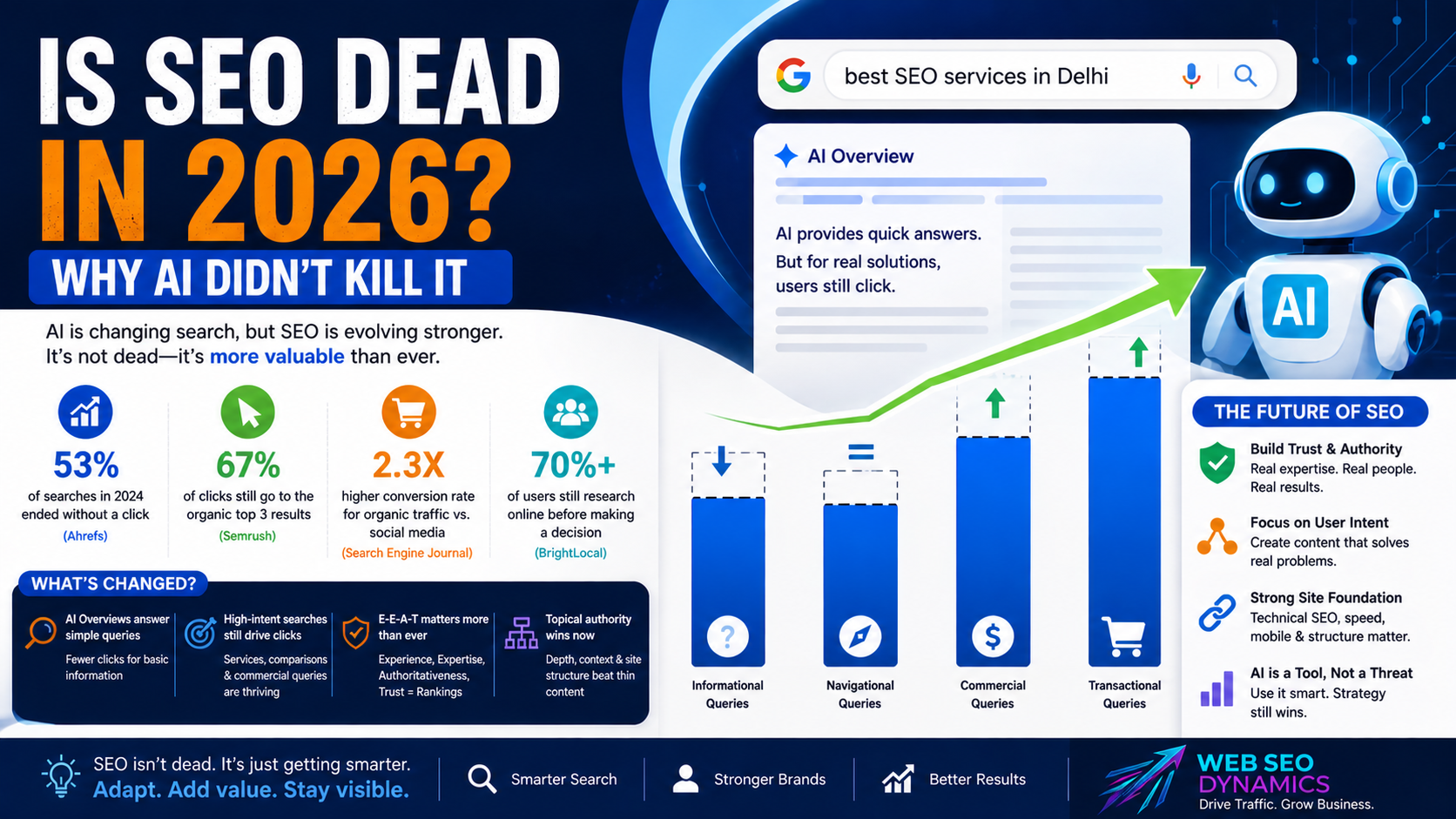
No—SEO isn't dead in 2026. What actually changed is where clicks come from and which pages deserve them. Since late 2023, Google has been answering more queries directly on the results page, which reduced traffic for simple informational queries. But data across multiple studies shows that high-intent searches—services, comparisons, pricing—still generate clicks and conversions. SEO didn't die; low-value content lost distribution.
Why "SEO is dead" became such a loud narrative
The noise didn't come out of nowhere. When Google began rolling out AI-generated answers and expanding rich results, a visible shift happened in click behavior. Research published by platforms like Ahrefs showed that a large percentage of searches were already "zero-click" even before full AI integration, meaning users found their answers without visiting a website. What AI did was accelerate that trend, not create it.
At the same time, volatility during core updates increased. Analysts like Barry Schwartz have documented repeated ranking turbulence during updates tied to quality signals. When entire sites lose visibility overnight, it's easy to jump to "SEO is over." But when you look closer, the pattern isn't random—it's selective.
What actually dropped after AI Overviews (and what didn’t)
The biggest misconception is that "traffic dropped everywhere." That's not what the data shows.
Studies from Semrush and Ahrefs indicate a split:
- Queries with simple informational intent (definitions, quick answers) saw reduced click-through rates because Google answers them directly.
- Queries with decision intent (best tools, pricing, services, comparisons) retained strong click behavior.
This aligns with how search has always worked—Google tries to resolve simple queries quickly and pushes users outward when decisions require depth.
Even Lily Ray has pointed out in multiple update analyses that sites hit hardest were often those relying on scaled, low-trust informational content. Meanwhile, sites with clear expertise, authorship, and brand signals maintained or improved visibility.
So the shift is not "SEO lost traffic." It's more precise:
SEO lost low-intent clicks and retained high-value ones.
What real case studies reveal about ranking changes
If you look at breakdowns by Glenn Gabe after major core updates, a consistent pattern shows up. Sites that recovered or grew typically had:
- Strong topical depth across related subjects
- Clear signals of expertise (authorship, real-world credibility)
- Content that answered layered queries, not just surface-level questions
Sites that declined often had large volumes of content but weak differentiation. This distinction matters because it explains why AI didn’t replace SEO—it exposed which SEO was shallow.
From a data perspective, platforms like Semrush have also published findings showing that AI-assisted content performs competitively only when paired with editorial oversight and structured intent targeting. Pure automation doesn’t sustain rankings. That’s not speculation; it’s visible in performance datasets across industries.
The Real Shift: From “Ranking Pages” to “Earning Distribution”
Earlier SEO models were page-centric. You could rank a single well-optimized page for a keyword and generate traffic. That model is weakening.
Search systems now evaluate context and coverage, not just individual pages. This is where frameworks discussed by people like Koray Tuğberk Gübür become relevant—ranking is increasingly tied to how well a site covers a topic as a whole.
At the same time, Google’s own guidance through Google Search Central has been consistent: content should demonstrate experience, expertise, authoritativeness, and trust. That’s not new—but enforcement is much stricter now.
So instead of asking "how do I rank this page," the better question in 2026 is:
"Why should Google trust this entire site on this topic?"
Where AI actually fits into SEO
AI didn’t remove the need for SEO—it compressed the margin for error.
Content can now be generated quickly by anyone. That means content itself is no longer a differentiator. What differentiates is:
- How well the content matches intent
- Whether it adds something beyond what already exists
- Whether the source is trusted
Data from Semrush and industry testing shows that AI-generated content can rank, but it doesn’t hold positions unless it’s structured, reviewed, and aligned with user intent. In other words, AI helps produce content—but it doesn’t create authority.
That’s why even Google representatives like John Mueller have emphasized that AI-generated content isn’t inherently bad—but low-quality content, regardless of how it’s created, won’t perform.
The Future of SEO is narrower—but more valuable
What’s interesting is that SEO hasn’t just survived—it’s becoming more economically meaningful.
If informational traffic declines but decision-stage traffic remains, then each visitor becomes more valuable. Businesses are no longer competing for empty pageviews; they’re competing for users who are closer to action.
That’s also why service-oriented pages, structured comparison content, and well-designed websites are performing better. SEO is no longer just about content—it’s about how content, structure, and user journey work together.
This is where the overlap between a solid SEO Service in Delhi and a properly executed Web Design Service becomes obvious. Ranking alone doesn’t matter if the page doesn’t convert, and in 2026, Google increasingly favors pages that satisfy both intent and usability.
So, is SEO dead—or just misunderstood?
SEO isn’t dead. But the version of SEO that worked five years ago is.
What we’re seeing now is a filtration process. Search engines are better at identifying:
- Redundant content
- Unverified information
- Sites without real authority
And they are redistributing visibility toward sources that demonstrate depth and trust.
That’s why the conversation around “SEO after AI” feels confusing. People are observing real changes—but mislabeling them.
The reality is simpler:
AI didn’t kill SEO. It removed the shortcuts.
Final Takeaway
If someone built their strategy around volume—more blogs, more keywords, more pages—it’s going to feel like SEO stopped working. But if the strategy is built around intent, authority, and structured coverage, SEO is still one of the most reliable growth channels available.
So the question isn't "is SEO dead."
It’s whether your approach to SEO belongs to 2020—or 2026.
FAQs
Is SEO dead in 2026?
No. It has evolved due to AI and changes in search behavior, but it remains essential for visibility and conversions.
Has AI reduced organic traffic?
For simple informational queries, yes. For high-intent queries, traffic remains strong and valuable.
What is the future of SEO?
It is shifting toward topical authority, trust signals, and intent-driven content rather than isolated keyword targeting.
Does AI replace SEO experts?
No. AI assists execution, but strategy and intent mapping still require human expertise.
Why are some websites losing rankings?
Mostly due to weak E-E-A-T signals, low-quality content, or outdated SEO practices.
Is blogging still effective?
Yes, but only when it contributes to a broader topical and strategic framework.