Nofollow vs Dofollow vs Noopener vs Noreferrer: What Actually Matters for SEO
English Podcast
हिंदी पॉडकास्ट
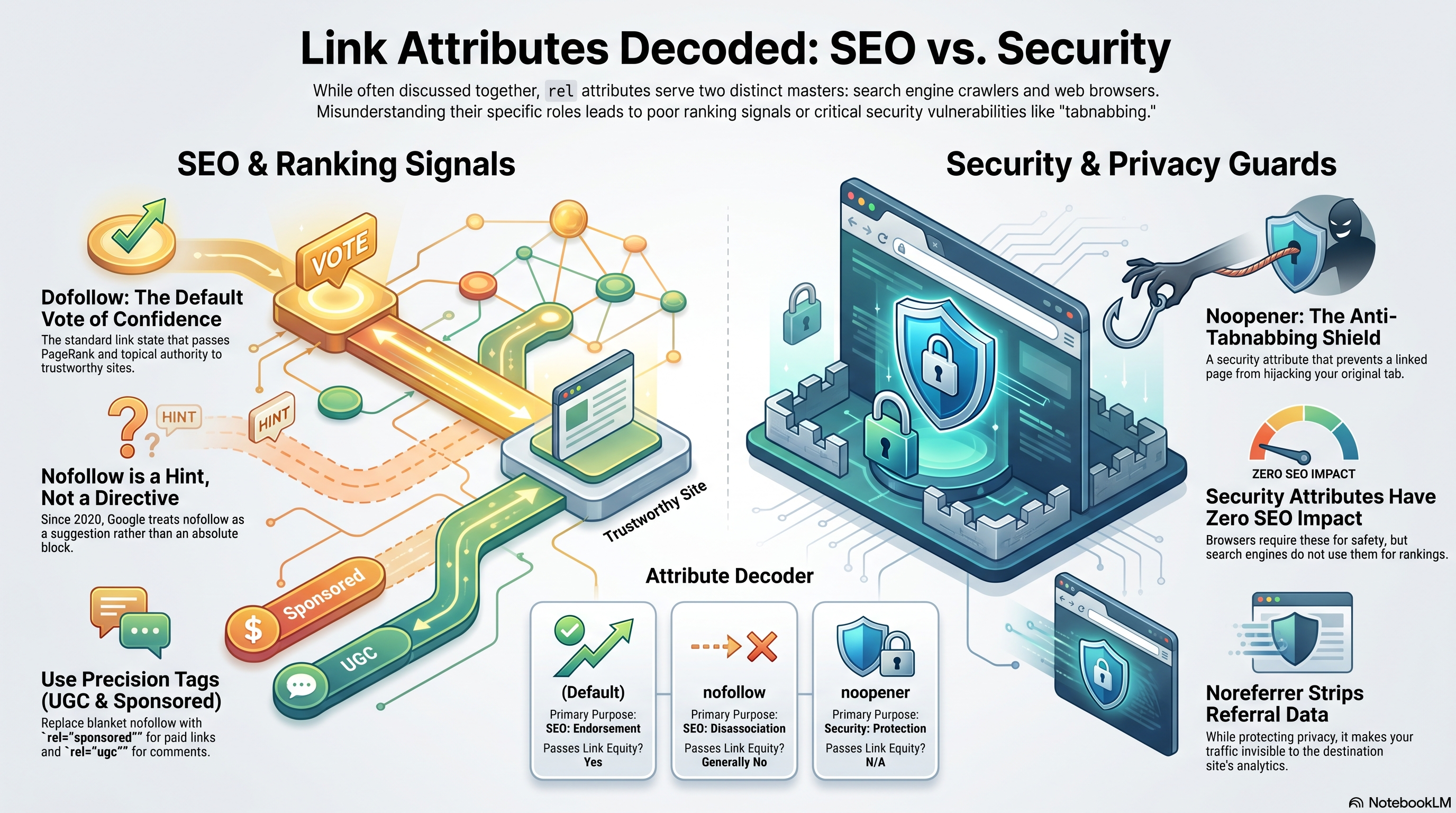
If you’ve spent any time in an SEO forum, you’ve seen these four terms thrown around like they belong in the same conversation. They don’t — not really. Two of them are about search engine ranking signals. Two of them are about browser security. Mixing them up is one of the most common technical SEO mistakes, and it usually leads to either wasted effort or, worse, a security hole left open on your site.
Here’s the breakdown, from the ground up.
The rel attribute: one tag, several jobs
All four of these live inside the rel attribute on an <a> tag:
<a href="https://webseodynamics.com" rel="nofollow">Webseodynamics</a>
      <a href="https://webseodynamics.com" rel="noopener noreferrer" target="_blank">Webseodynamics</a>
rel just tells the browser or search engine “here’s the relationship between this link and the destination.” Depending on which value you use, that relationship gets interpreted completely differently by two different audiences: search engine crawlers, and web browsers.
Dofollow: the default that doesn’t officially exist
There is no rel="dofollow" attribute. It’s not in the HTML spec and never has been. A “dofollow” link is simply a normal <a href> with no rel annotation at all — the default state of every link on the web. When someone says “make sure that’s a dofollow link,” they mean “don’t add nofollow to it.”
SEO impact: Dofollow links are how PageRank and topical authority flow between pages. When a trustworthy site links to you without any qualifying attribute, it’s treated as a vote of confidence, and that vote can influence your rankings. This is still the backbone of link-based ranking signals in 2026, even as Google leans more heavily on content quality and topical relevance.
Nofollow: a hint, not a wall
Google introduced rel="nofollow" back in 2005 to fight comment-spam link schemes. For years, it worked as a hard directive — a nofollowed link was a dead end for crawlers.
That changed in March 2020. Google now treats nofollow, along with the newer sponsored and ugc values, as hints for ranking purposes rather than absolute rules. In practice, that means Google may still crawl, index, or even weigh a nofollowed link if its systems decide the link is useful — nofollow is a strong request, not a guarantee.
Alongside that shift, Google split the old catch-all nofollow into three more precise values:
rel="nofollow"— general “I don’t want to vouch for or be associated with this” signalrel="sponsored"— for paid or compensated linksrel="ugc"— for user-generated content, like forum posts and blog comments
These can be combined on a single link (e.g., rel="ugc sponsored"), and Google can crawl any link carrying these attributes except that nofollow can also be applied as a robots meta tag.
SEO impact: Nofollow links generally don’t pass direct link equity, so they aren’t the primary lever for boosting rankings. They’re not worthless, either. High-authority nofollow links from sites like major news outlets or Wikipedia still drive real referral traffic, build brand visibility, and contribute to a natural-looking backlink profile. A backlink profile that’s 100% dofollow actually looks suspicious to search engines, because organic, earned visibility naturally produces a mix of both. Most healthy profiles land somewhere in the 25–50% nofollow range, partly because social platforms and UGC sites nofollow almost everything by default.
Noopener: security, not SEO
rel="noopener" has nothing to do with search rankings. It’s a browser security attribute, almost always paired with target="_blank" (links that open in a new tab).
Without noopener, a page you link to gets partial access to your original page via window.opener — technically allowing it to redirect your original tab to a malicious page (a technique called “tabnabbing”). Adding noopener severs that connection.
SEO impact: None, directly. Google’s crawlers don’t use noopener as a ranking signal. Confusing it with nofollow is one of the more common technical SEO mix-ups — people assume it affects link equity, and it simply doesn’t.
Noreferrer: privacy, not SEO either
rel="noreferrer" does everything noopener does (blocks the window.opener reference) and strips the Referer header, so the destination site can’t see where the traffic came from.
SEO impact: Also none directly. But there’s a nuance worth knowing: if you care about your own analytics on outbound clicks, or if you want other sites to see (and credit) you as a referral source, overusing noreferrer on your own outbound links can work against you in a roundabout way — not because it hurts your rankings, but because it makes your site invisible in other people’s referral traffic data, which can affect relationship-building.
Quick reference
| Attribute | Category | Passes link equity? | Affects rankings? | Primary purpose |
|---|---|---|---|---|
| (none) — “dofollow” | SEO | Yes | Yes | Default endorsement |
nofollow | SEO | Generally no (hint-based) | Indirectly | Disassociate without full block |
sponsored | SEO | No | Indirectly | Flag paid/affiliate links |
ugc | SEO | No | Indirectly | Flag user-generated links |
noopener | Security | N/A | No | Block window.opener access |
noreferrer | Security/Privacy | N/A | No | Block opener access + hide referrer |
The core takeaway
If you’re optimizing for SEO, your decisions revolve entirely around dofollow, nofollow, sponsored, and ugc — and the real 2026 best practice is honesty and precision: tell Google exactly what kind of link this is, rather than defaulting everything to nofollow or leaving everything dofollow.
noopener and noreferrer matter for a completely different reason — protecting your users and your site from tabnabbing and unwanted data leakage when links open in new tabs. Handle them as a security/UX checklist item, not a ranking lever. Treating them as SEO attributes just means you’re solving the wrong problem, and possibly leaving a real security gap unaddressed while you do it.