Back to Blog List
strategy

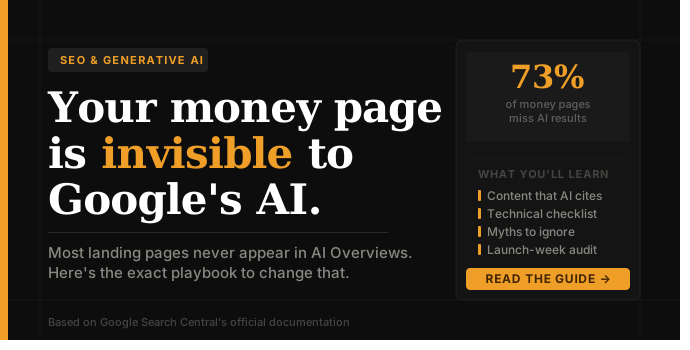
How to Get Your Client's Money Page Ranking in Google's AI Search

By:
Published:
Updated:
📖 Reading Time: 9 min read
How to Get Your Client's Money Page Ranking in Google's AI Search - strategy
Client SEO  ·  Generative AI Search  ·  Conversion Pages

How to Get Your Client's Money Page Ranking in Google's AI Search

The landing page that drives your client's leads, demos, and sales — here's the complete playbook to make Google's AI Overviews and AI Mode cite, recommend, and link to it.

Actionable For SEO professionals Based on Google's official guide ~15 min read
What's in this guide
  1. What a "money page" means in AI search and why it's harder to rank now
  2. The content quality bar your page must clear
  3. Technical SEO foundations that unlock AI visibility
  4. Product & service optimizations for AI responses
  5. What NOT to do (AI SEO myths that waste your time)
  6. Launch-week checklist for a newly built money page

What a "money page" means in Google's AI search context

A money page is the landing page that does the revenue work — a service page, a product page, a "Book a Demo" or "Get a Quote" page. It's the page you drive paid and organic traffic to because when it converts, the client makes money.

In traditional SEO, the goal was a top-3 blue link. In Google's AI search, the game has shifted. AI Overviews and AI Mode now sit above the fold and directly answer commercial queries like "best digital marketing agency for e-commerce" or "top rated HVAC service in Delhi." If your client's money page isn't in that AI-generated response, you're invisible to a growing segment of high-intent searchers.

Key context
Google's AI features use the same core Search index and ranking signals as traditional results. There is no separate "AI algorithm" to game — optimizing for AI search is optimizing for Search. The difference is that AI surfaces the most credible, specific, and useful content — and ignores the rest.

The content quality bar your money page must clear

Google's generative AI systems are specifically designed to surface content that a human visitor would find satisfying. For a money page, this means the page must justify why the client's product or service is the right answer to the searcher's problem — not just describe it.

"A first-hand review provides a unique perspective based on personal experience, whereas a summary of existing content simply restates information already available elsewhere." — Google Search Central

Most client money pages fail this test because they're written from the inside out — features, pricing, generic CTAs. AI search rewards pages written from the outside in: what the customer actually needs, what makes this offering genuinely different, and what proof backs it up.

Commodity vs. non-commodity money pages

Commodity (AI will skip this)

"Professional Web Design Services"We offer fast, affordable, responsive web design for businesses of all sizes. Contact us today for a free quote.

Non-commodity (AI cites this)

"E-commerce Web Design That Reduced Cart Abandonment by 34%"How we rebuilt checkout flows for 40+ Shopify brands — with case studies, timelines, and real conversion data.

The difference isn't tone — it's specificity and proof. Google's AI systems are scanning for pages that provide unique, expert-led insight that couldn't be replicated by anyone.

How to add non-commodity value to any money page

Lead with the outcome, not the offeringInstead of "We offer PPC management," try "How our PPC campaigns generated 3.2x ROAS for a D2C skincare brand in 90 days." Specificity signals genuine expertise to AI systems.
Include proof elements that only your client can ownReal case study metrics, named client results (with permission), before/after data, or methodology explanations that a competitor couldn't simply copy.
Answer the real pre-purchase questionsWhat does it cost? How long does it take? What makes you different from the agency/tool/service next to you? AI systems pull from pages that genuinely answer what searchers want to know.
Add a unique point of view sectionA "Why we do X differently" or "Our philosophy on Y" section provides the kind of distinctive perspective that AI systems are actively looking to surface over generic competitors.
Use rich visuals with real contentProcess diagrams, before/after screenshots, result charts — these give AI search additional image content to cite and signal depth of content to ranking systems.
Show trust signals prominentlyAccreditations, awards, years in operation, and client logos aren't just for human visitors. These are the kind of authoritative signals that help Google's AI systems evaluate whether a page is worth citing.

Technical SEO foundations that unlock AI visibility

A money page that can't be crawled, indexed, and served with a snippet cannot appear in AI Overviews or AI Mode — regardless of how good the content is. These are the technical prerequisites:

1
Confirm the page is indexed and snippet-eligible

Use the URL Inspection tool in Google Search Console. Verify there's no accidental noindex tag, no "no snippet" directive, and no soft 404. If it's not indexed, it's invisible to AI features.

2
Structure the page with clear, semantic headings

The page's H1 should reflect the core commercial intent. H2s should answer specific questions a prospect would have. This helps AI systems parse and extract the right content for relevant queries.

3
Pass Core Web Vitals — especially on mobile

High-intent commercial queries increasingly happen on mobile. LCP under 2.5s, CLS under 0.1, INP under 200ms. Page experience is a ranking factor that directly affects AI feature eligibility.

4
Make your content crawlable, not locked in JavaScript

If the page's key selling points, case studies, or service details are rendered client-side via JavaScript, Googlebot may not see them. Use server-side rendering for critical above-the-fold content.

5
Eliminate duplicate versions of the page

HTTP/HTTPS, trailing slash, www/non-www — canonical tags must point to one definitive URL. Fragmented authority across duplicate URLs hurts the page's ability to rank in both standard and AI results.

6
Add structured data for your service or product type

While not required for AI visibility, LocalBusiness, Service, Product, and FAQPage schema make the page eligible for rich results — and the enhanced appearance in SERPs drives clicks that signal quality to Google's systems.

7
Ensure the page is easy to navigate for real users

AI features consider page experience signals. If users bounce immediately due to confusing layout, aggressive popups, or hard-to-read text, that behavioral data works against the page's long-term visibility.

Product & service optimizations for AI responses

Google's AI features can directly pull product listings, service descriptions, and local business details into responses. For a client's money page, these are the easiest wins to set up alongside on-page work:

Action Best for Impact
Google Business Profile
Complete every field — category, hours, photos, services, Q&A, reviews
Local service businesses, agencies, brick-and-mortar clients High
Google Merchant Center feed
For clients selling physical or digital products
E-commerce, SaaS with clearly defined product tiers High
Review generation strategy
Google, G2, Trustpilot, Clutch — depending on the client's industry
All business types — AI surfaces what's being said across the web High
FAQPage schema on the money page
Answer the 5-6 most common pre-purchase questions directly on the page
High-consideration B2B services, home services, legal, healthcare Medium
Business Agent on Google Search
A conversational experience for customers to chat with the brand directly
E-commerce, hospitality, high-volume service inquiries Emerging
Common mistake
Many SEOs optimise the money page but ignore the client's Google Business Profile and third-party review presence. In AI search, Google assembles responses from multiple sources. If the off-page signals don't support the on-page content, the page loses to competitors that have both.

What not to do: AI SEO myths that waste your time

A whole industry of "GEO" and "AEO" advice has emerged around generative AI search. Most of it is either unverified or explicitly contradicted by Google. Protect your client relationships by ignoring these:

Myth
Create an llms.txt file

Google does not treat this file as special. It won't boost your client's visibility in AI features.

Myth
"Chunk" the landing page

Breaking the page into bite-sized sections for AI is unnecessary — Google understands full pages naturally.

Myth
Spin up 50 keyword variants

Creating near-duplicate money pages for every service variation triggers Google's scaled content spam policy.

Myth
Buy brand mentions to influence AI

Google's spam filters apply to AI features too. Inauthentic mentions don't move the needle and can trigger penalties.

Myth
Rewrite content with AI-specific phrasing

AI systems understand synonyms and intent. Writing in a specific "AI-friendly" style is not a ranking signal.

Myth
Overload the page with schema

Structured data is helpful for rich results but is not a prerequisite for AI Overviews or AI Mode visibility.

Launch-week checklist for a newly built money page

Use this as your standard QA process every time you launch or refresh a client's money page:

Page is indexed and snippets are enabled in Search ConsoleRun URL Inspection. Confirm no noindex, no-snippet, or coverage errors blocking the page.
H1 reflects the core commercial intent of the pageNot the client's internal naming. The language real searchers use when looking for this product or service.
Page contains at least one unique proof elementA stat, a case study result, a named outcome, or a methodology that a competitor cannot simply replicate.
Pre-purchase questions are answered on the pageCost range, timeline, what differentiates them, what the process looks like. Don't force the user to call or email to find out.
Core Web Vitals pass on mobileRun PageSpeed Insights. Fix LCP, CLS, and INP. A slow or janky page harms both conversion rate and AI search visibility.
Google Business Profile is complete and consistentBusiness name, address, category, services, and photos should all match what's on the landing page.
At least one high-quality image with descriptive alt textReal photography of the team, work, or product — not stock imagery. AI features can surface images alongside web results.
Canonical tag points to the correct URLOne clean, definitive version of the page. No duplicate parameters, no duplicate HTTP/HTTPS or www/non-www versions.
Internal links from high-authority pages on the domain point hereThe money page should be well-connected internally. Orphaned landing pages struggle to accumulate the signals needed for AI visibility.
A review generation plan is in placeReviews on Google, Clutch, G2, or Trustpilot (depending on the industry) directly influence what AI systems say about the business when answering commercial queries.
The core principle
Before signing off on any money page, ask yourself: "If Google's AI were writing a recommendation for this service, would this page give it enough evidence to do that confidently?" If the answer is no — add the proof, specificity, and depth until it is.

Need a custom content or technical audit for your client's money page?

About Webseo Dynamics Team

Webseo Dynamics Team is a dedicated team of experienced SEO professionals with expertise in digital marketing and search engine optimization. With years of combined industry experience, the team shares valuable insights and best practices to help businesses grow online and achieve their digital marketing goals.

Our Location