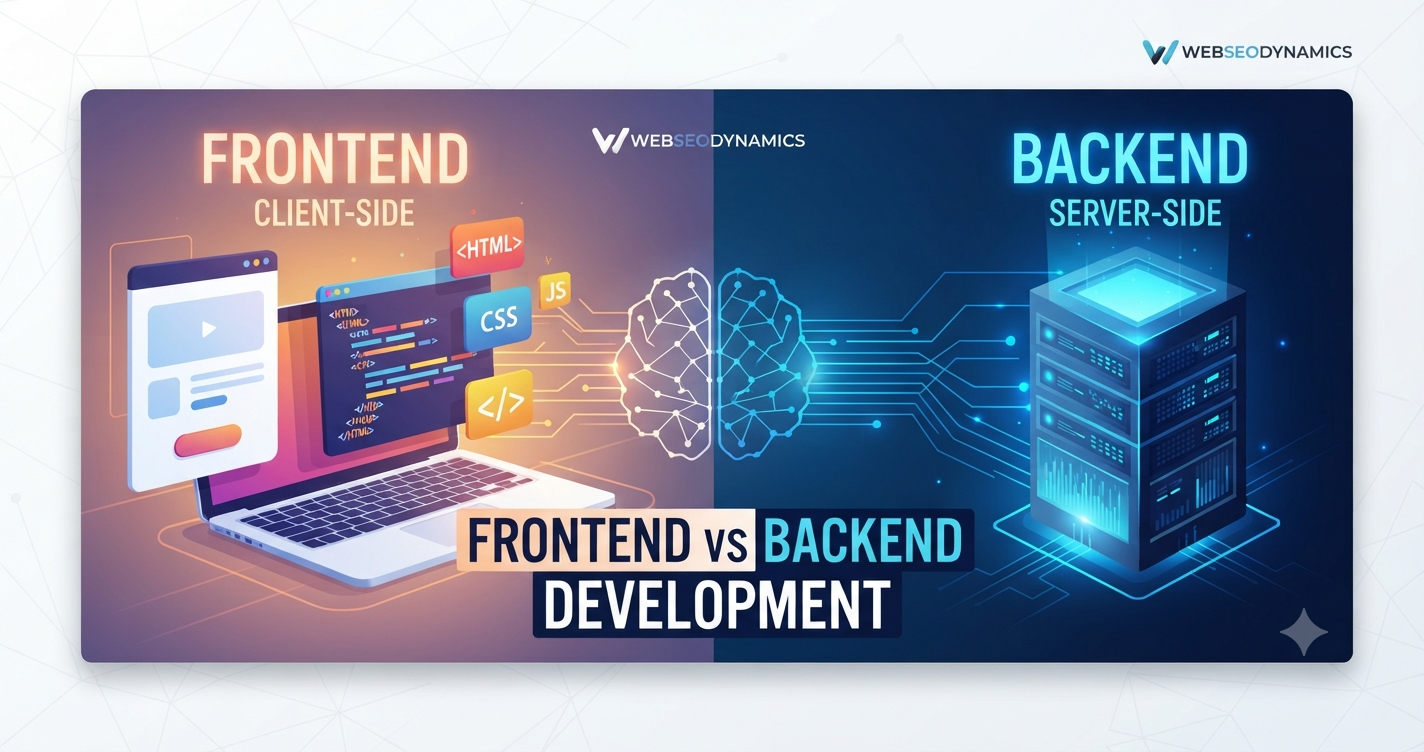
Frontend vs Backend Development: What's the Difference and Which Do You Need?
When users open a website, they experience a polished interface filled with vibrant imagery, smooth navigation menus, responsive buttons, and structured text. To the average visitor, that seamless interface is the website itself. However, that sleek layer is merely the tip of a massive digital iceberg. Beneath that surface-level presentation lies an intricate network of servers, databases, security protocols, routing engines, and application logic working in synchronized harmony.
This division forms the core architecture of web engineering, categorized cleanly into two distinct disciplines: Frontend Development and Backend Development. For business owners, entrepreneurs, and project managers stepping into the digital ecosystem, understanding how these two domains interact is not just a technical luxury—it is a financial and strategic necessity. Building a digital product without knowing your architecture requirements leads to bloated budgets, delayed timelines, and poor scalability.
In this guide, we'll unpack the exact definitions, technologies, architectural mechanics, and business use cases for both frontend and backend development, so you have clarity on which stack aligns with your goals.
1. The Anatomy of Modern Web Architecture
Before zooming into individual components, it helps to visualize a modern web application as a sophisticated restaurant. The Frontend is the dining room—the seating arrangement, table settings, menus, and the waiter who interacts directly with the guest. The Backend is the commercial kitchen—where ingredients are stored, meals are prepped, recipes are executed, and inventory is managed. Without the dining room, guests have nowhere to sit; without the kitchen, there is no food to serve.
In software engineering terms, this is known as the client-server architecture model. The client (browser or mobile app) sends requests across the internet using HTTP/HTTPS protocols, and the server processes those requests, fetches or modifies data, and sends a structured response back to the client.
2. What is Frontend Development? (The Client-Side)
Frontend development, commonly referred to as client-side development, encompasses everything that a user directly views, touches, and experiences in their browser window. The primary objective of a frontend engineer is to translate UI/UX wireframes into functional, interactive, accessible, and high-speed digital interfaces.
When you click a dropdown menu, toggle a dark mode switch, fill out a contact form, or watch a product image zoom in on an e-commerce catalog, you are experiencing frontend code execution. This code runs directly on the user's device, rendered by the browser's layout engine (such as Blink in Chrome or WebKit in Safari) and executed by its JavaScript engine (such as Google's V8).
The Building Blocks of Frontend
Every frontend experience on the web is built upon three core technologies:
- HTML5 (HyperText Markup Language): The structural skeleton of a webpage. It defines headings, paragraphs, lists, tables, media embeds, and semantic landmarks required for both human readers and search engine crawlers.
- CSS3 (Cascading Style Sheets): The visual wardrobe and makeup. CSS dictates color schemes, typography, layout structures (using Flexbox and CSS Grid), animations, responsiveness across mobile and desktop devices, and modern visual themes.
- JavaScript (ES6+): The behavioral nervous system. JavaScript introduces dynamic interactivity—such as validating user input before submission, updating shopping carts without page reloads, building interactive maps, and fetching asynchronous data via APIs.
Modern Frontend Ecosystem and Frameworks
While vanilla HTML, CSS, and JS are sufficient for basic sites, modern enterprise applications require component-driven development to handle scale, modularity, and rapid feature deployment. Today's ecosystem relies heavily on powerful libraries and frameworks:
- React: Developed by Meta, React is a component-based library that uses a virtual DOM and a reconciliation process to efficiently render dynamic user interfaces.
- Vue.js: Known for its gentle learning curve and elegant reactivity system, Vue is a progressive framework loved by fast-growing startups.
- Angular: Backed by Google, Angular is a robust, opinionated, TypeScript-based framework designed for massive enterprise-grade single-page applications (SPAs).
- Next.js & Nuxt.js: Full-stack frontend frameworks that introduce Server-Side Rendering (SSR) and Static Site Generation (SSG), which are critical for SEO performance and lightning-fast initial load times.
3. What is Backend Development? (The Server-Side)
If the frontend is the shining showroom floor, the backend is the factory, vault, and logistical command center combined. Backend development, or server-side development, operates entirely away from the user's direct vision. It manages the underlying business logic, database operations, user authorization, server orchestration, and third-party API integrations.
Consider what happens when a user logs into an online banking dashboard. The user enters their credentials on the frontend form. The frontend securely packages those credentials and transmits them via an API request to the backend server. The backend checks the data against encrypted records inside a database, verifies the user's authorization token, generates a session cookie, and returns a success response—all within milliseconds.
The Building Blocks of Backend Architecture
A robust backend infrastructure rests upon three fundamental pillars:
- The Server: The remote computer hosting the web application files, listening for client requests, and executing code. Modern servers are often cloud-managed virtual machines hosted on AWS, Google Cloud Platform (GCP), or Microsoft Azure.
- The Database: The persistent storage layer where user records, product catalogs, transaction logs, and operational data are saved securely. Databases are categorized into relational (SQL: PostgreSQL, MySQL) and non-relational (NoSQL: MongoDB, Redis).
- Server-Side Languages & Frameworks: The programming environment that processes incoming requests. Popular choices include Node.js (JavaScript), Python (Django/Flask), PHP (Laravel), Ruby on Rails, and Java (Spring Boot).
APIs and Communication Channels
The bridge connecting the frontend and backend is the API (Application Programming Interface). Using RESTful architectural principles or GraphQL queries, the backend exposes endpoints that the frontend can call to retrieve or update data without reloading the entire application page. This decoupling allows frontend and backend teams to build and scale their systems independently. For a deeper technical reference, see MDN's HTTP documentation.
Frontend at a Glance
- Directly visible and interactive for users
- Executes inside the browser (client-side)
- Primary focus: UI/UX, responsiveness, speed
- Key metrics: Core Web Vitals (LCP, CLS, INP)
- Core tech: HTML, CSS, JavaScript, React
Backend at a Glance
- Hidden infrastructure running on remote servers
- Executes on cloud servers (server-side)
- Primary focus: Logic, security, data processing
- Key metrics: Latency, throughput, query speed
- Core tech: Node.js, Python, SQL, AWS
4. Key Differences: Frontend vs. Backend Development
To further clarify the distinction, let's examine the operational contrasts across four primary dimensions:
A. User Visibility and Direct Access
Frontend code is downloaded directly onto the visitor's machine. Anyone can right-click a webpage, select "Inspect," and view the raw HTML, CSS, and client-side JavaScript. Conversely, backend code is securely sequestered on a remote server. Users cannot see or tamper with backend source code, database credentials, or server configurations unless a critical security flaw exists.
B. Performance Optimization Focus
Frontend optimization revolves around minimizing bundle sizes, optimizing images, leveraging browser caching, and passing Google's Core Web Vitals benchmarks (Largest Contentful Paint, Cumulative Layout Shift, Interaction to Next Paint). Backend optimization focuses on reducing database query execution times, scaling server clusters via load balancing, managing memory allocation, and lowering API response latencies.
C. Security Protocols
Frontend security deals primarily with preventing Cross-Site Scripting (XSS) and ensuring safe data rendering. Backend security tackles much heavier threats, including SQL Injection, Cross-Site Request Forgery (CSRF), brute-force attacks, multi-factor authentication enforcement, and secure token management (JWT, OAuth 2.0).
D. Mindset and Problem Solving
Frontend developers approach problems through an artistic and empathetic lens—balancing human psychology, accessibility (WCAG compliance), cross-browser compatibility, and aesthetic appeal. Backend developers operate like structural engineers and logicians—focusing on data pipelines, architectural design patterns, algorithm efficiency, and system resilience.
5. Which One Do You Need for Your Business Project?
Choosing between frontend alone, backend alone, or full-stack integration depends entirely on the functional requirements of your digital enterprise. Here is how to evaluate your business model:
Scenario A: You Only Need Frontend Development If...
You are building a static informational website, a corporate brochure site, a personal brand portfolio, or a high-converting marketing landing page. These digital properties focus purely on storytelling, brand visibility, and lead generation. Because they do not require user logins, secure accounts, database storage, or dynamic e-commerce checkout flows, a pure frontend structure built with clean HTML/CSS/JavaScript or static site generators is ideal, cost-effective, and exceptionally fast.
Scenario B: You Need BOTH Frontend and Backend Development If...
You are launching an enterprise web application, an e-commerce platform, a Software-as-a-Service (SaaS) tool, a booking portal, or a social network. These platforms require secure user authentication, persistent databases to store user data, payment gateway integrations (Stripe, PayPal), real-time notifications, and personalized dashboards. For these projects, a robust backend paired with a dynamic frontend is mandatory.
6. The Intersection of Development and SEO
Development choices directly affect organic search visibility. A poorly architected frontend can block search engine crawlers, while a slow backend increases server response time (Time to First Byte), which can hurt rankings.
An SEO-conscious approach to development means server-side rendering for indexable content, semantic HTML tagging, optimized asset delivery, and clean URL routing. When development and SEO work hand-in-hand, a site doesn't just look good — it performs well in search results too.
Frequently Asked Questions
Can one developer handle both frontend and backend?
Yes — this is called full-stack development. It's common on small teams and early-stage projects, though large-scale products typically split the roles as complexity grows.
Which is harder to learn, frontend or backend?
Neither is objectively harder — they require different skill sets. Frontend leans toward visual and UX problem-solving with a fast feedback loop; backend leans toward logic, data modeling, and systems thinking with a steeper initial learning curve around infrastructure.
Do I need a backend for a small business website?
Not necessarily. If the site is informational (hours, services, contact info) without logins or transactions, a frontend-only static site is usually sufficient and cheaper to build and maintain.
Conclusion
Frontend and backend development are two halves of the exact same digital coin. The frontend captures attention, engages users, and delivers a memorable brand experience, while the backend secures data, processes business logic, and guarantees system stability. Recognizing their differences enables you to make informed decisions when investing in your company's digital infrastructure.
Ready to Build a High-Performance Web Presence?
At Webseodynamics, we bridge the gap between robust full-stack web development and advanced SEO strategies. Whether you need a lightning-fast frontend interface or an enterprise-grade scalable backend, our experts are here to elevate your brand.
Get a Free Consultation Today