Single Page Applications (SPAs) vs Multi-Page Applications (MPAs): Performance & SEO
Few architectural decisions shape a website's technical trajectory as much as choosing between a Single Page Application and a Multi-Page Application. It affects how fast the site feels to navigate, how easily search engines can crawl and index it, how complex the development and hosting setup becomes, and how much ongoing engineering effort it takes to keep both performance and SEO healthy as the site grows.
The honest answer to "which is better" is that it depends heavily on what you're building — but the trade-offs are specific and well understood, not a matter of taste. This guide breaks down exactly how each architecture works, where each one genuinely wins, and how modern frameworks have blurred the line between the two more than the classic "SPA vs MPA" framing suggests.
1. What Is a Multi-Page Application?
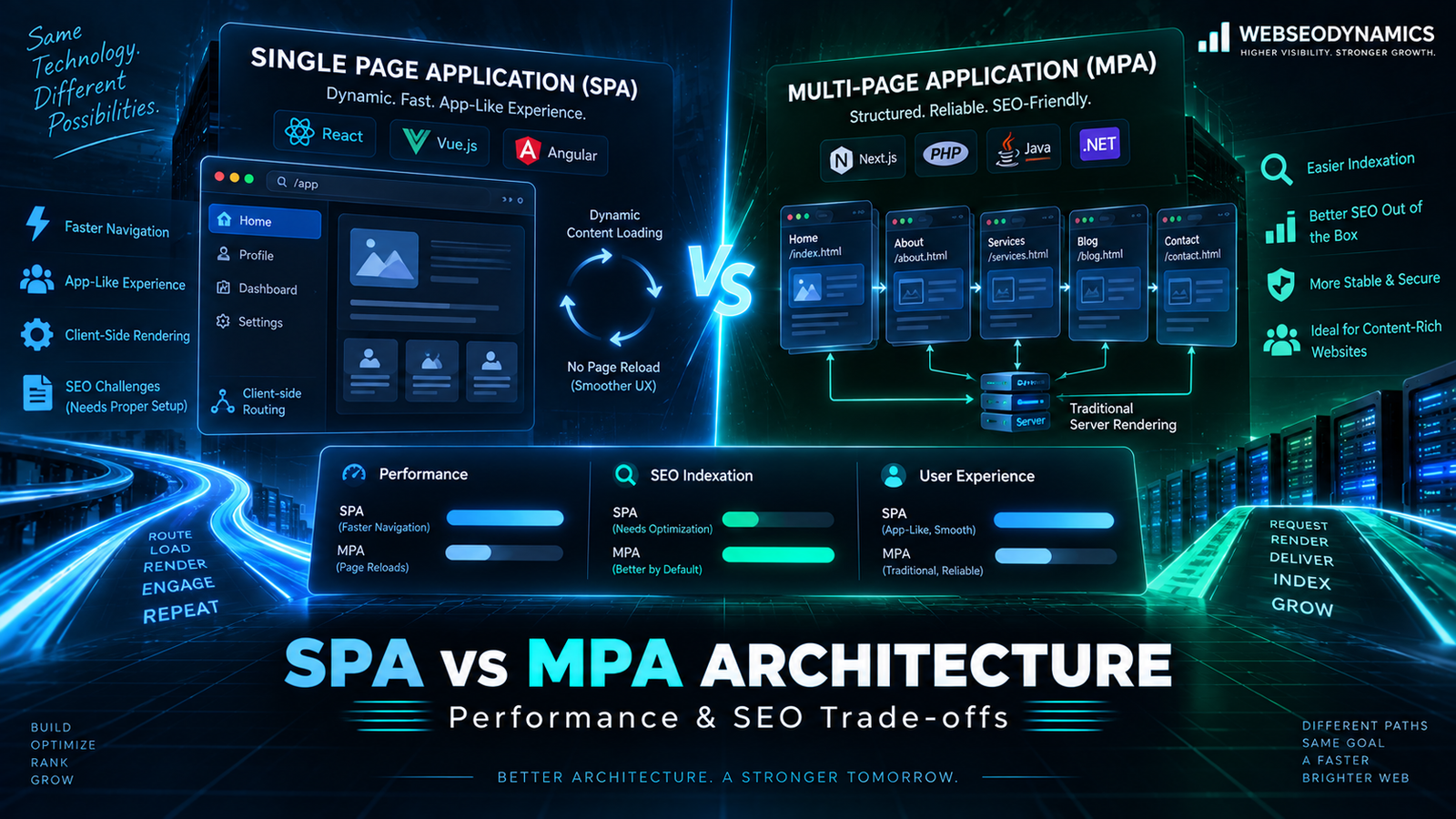
A Multi-Page Application follows the traditional web model: every distinct page or route corresponds to a separate HTML document, requested fresh from the server each time a user navigates. Clicking a link triggers a full page load — the browser discards the current page, requests a new one, and renders it from scratch, including re-downloading and re-parsing shared resources like the header and navigation unless they're cached.
Most traditional CMS-driven sites (WordPress, Drupal), e-commerce platforms, and content-heavy websites are built as MPAs, often because their content structure — many distinct, independently valuable pages meant to be individually discoverable and shareable — maps naturally onto this model.
2. What Is a Single Page Application?
A Single Page Application loads a single HTML shell once, then uses JavaScript to dynamically swap content in and out as the user navigates, without triggering a full page reload. Frameworks like React, Vue, and Angular power most modern SPAs, using client-side routing to update the URL and visible content while keeping the underlying page technically the same document throughout the session.
// Simplified client-side routing concept
window.addEventListener('popstate', () => {
  renderPageForPath(window.location.pathname);
});

function navigateTo(path) {
  history.pushState({}, '', path);
  renderPageForPath(path); // swaps content without a full reload
}
SPAs became popular for building app-like experiences — dashboards, tools with heavy interactivity, and products where users spend extended sessions performing many small actions — because avoiding full page reloads between those actions makes the experience feel instant and continuous, closer to a native application than a traditional website.
3. Performance Comparison
The performance comparison between SPAs and MPAs isn't a simple "one is faster" — it depends on which moment of the experience you measure.
MPA Performance Profile
- Typically faster initial load — the server sends fully formed HTML immediately
- Each navigation re-triggers a full load, which feels slower for frequent in-app actions
- Less JavaScript required for basic content pages, reducing main-thread work
SPA Performance Profile
- Often slower initial load — a JavaScript bundle must download and execute before content appears (unless server-rendered)
- Subsequent in-app navigation is typically much faster, since only data changes, not the whole document
- Higher ongoing memory and CPU usage during long sessions
A pure client-side-rendered SPA's biggest performance liability is the initial load: the browser must download the HTML shell, then fetch and execute JavaScript, then often make additional API calls before any real content appears — a sequence that can meaningfully delay Largest Contentful Paint compared to an MPA that ships content directly in the initial HTML response.
Once loaded, though, a well-built SPA's subsequent navigations can feel dramatically faster than an MPA's, since moving between views only requires fetching new data (often a small JSON payload) rather than re-downloading and re-rendering an entire HTML document, including shared assets like the header, footer, and navigation.
4. SEO Comparison
This is where the two architectures historically diverge most sharply. MPAs are inherently SEO-friendly: each page has its own URL, its own complete HTML content, and search engine crawlers can index it the same way they've indexed the web for decades — by requesting the URL and reading the HTML response directly.
Pure client-side-rendered SPAs create real friction for search engines. If a crawler requests the page and receives a nearly empty HTML shell with a `<div id="root"></div>` that only fills with content after JavaScript executes, the crawler needs to actually execute that JavaScript to see the real content — which Google's crawler can do, but with meaningful caveats:
- Rendering happens in a second wave: Google typically crawls and indexes the initial HTML first, then queues the page for JavaScript rendering separately, which can introduce a delay before the fully rendered content is indexed.
- Other crawlers may not execute JavaScript at all: Bots for social media link previews, some SEO tools, and other search engines may only read the raw, unexecuted HTML — meaning a client-side-only SPA can show blank previews when shared on social platforms.
- Client-side routing can complicate URL structure: If routes aren't managed carefully with the History API and proper server-side fallback configuration, individual "pages" within an SPA may not correspond to genuinely crawlable, shareable URLs at all.
5. How Modern SPAs Solve the SEO Problem
The "SPAs are bad for SEO" framing is increasingly outdated in isolation, because modern frameworks rarely ship pure client-side rendering for anything that needs to be indexed. Several approaches close the gap:
- Server-Side Rendering (SSR): The server renders the initial HTML for each request, complete with real content, then the SPA's JavaScript "hydrates" it into an interactive application in the browser. This gives crawlers (and users) fully formed HTML immediately, while retaining the SPA's fast client-side navigation after the first load. Next.js and Nuxt.js are the most common frameworks implementing this pattern for React and Vue respectively.
- Static Site Generation (SSG): Pages are pre-rendered to static HTML at build time rather than on each request, ideal for content that doesn't change per-visitor, offering the crawlability of an MPA with the fastest possible serving (often from a CDN edge cache) and the interactive capabilities of an SPA once JavaScript loads.
- Incremental Static Regeneration / hybrid rendering: A middle ground where most pages are statically generated but can be regenerated periodically or on-demand, balancing the performance of static content with the freshness of dynamic data.
- Dynamic rendering (legacy approach): Serving a pre-rendered version specifically to detected crawlers while serving the full client-side rendered version to real users. This was more common before SSR frameworks matured, and Google itself has described it as a workaround rather than a long-term best practice.
In practice, most serious modern SPA-style projects that care about SEO use SSR or SSG rather than pure client-side rendering — meaning "SPA vs MPA" today is less a hard binary and more a spectrum of rendering strategies, several of which combine benefits from both original models.
6. Navigation and User Experience
Beyond raw performance numbers, the two architectures produce genuinely different navigation experiences. SPAs can preserve UI state across navigation — a video keeps playing in a mini-player while a user browses other content, a form's unsaved input survives a sidebar navigation, or a shopping cart drawer stays open. MPAs reset this state on every navigation, since each page load starts fresh.
The trade-off is that SPAs need to handle things browsers historically did for free — the back button, scroll position restoration, focus management, and loading states between "page" transitions — as deliberate engineering work. A poorly implemented SPA can actually feel worse than a traditional MPA if these details are neglected, since users lose expected browser behaviors without gaining a genuinely better replacement.
7. Which One Should You Use?
MPA (or SSR/SSG) Fits Best For
- Content sites, blogs, and marketing pages relying on organic search traffic
- E-commerce catalogs where individual product pages need strong SEO
- Sites where most visitors land on one specific page from search or social, rather than browsing extensively within the site
SPA Fits Best For
- Logged-in applications, dashboards, and internal tools not meant to be indexed
- Products where users perform many rapid, interactive actions within long sessions
- Experiences that genuinely benefit from persisted UI state across "pages"
Many real products land somewhere in between deliberately: a marketing site and blog built as SSR or SSG for SEO and fast initial loads, with a logged-in application section built as a more traditional client-rendered SPA once a user has authenticated and SEO is no longer a consideration for that part of the product.
8. Common Mistakes
- Building a content-heavy, SEO-dependent site as a pure client-side SPA: This is the single most common and costly mistake — choosing an architecture optimized for app-like interactivity for a site whose actual goal is organic search visibility.
- Forgetting server-side URL fallback configuration: An SPA with client-side routing needs the server configured to return the SPA's HTML shell for any route, not a 404, or direct navigation to a deep link (rather than clicking through from the homepage) will break.
- Ignoring meta tag updates on client-side navigation: Title tags, meta descriptions, and Open Graph tags need to update as the SPA's client-side router changes views — otherwise every "page" shares the same title and description regardless of what's actually displayed.
- Shipping the entire application bundle on first load: Without code splitting by route, an SPA forces every visitor to download code for parts of the application they may never use, inflating the initial load time unnecessarily.
- Assuming SSR is a one-time setup cost with no ongoing complexity: Server-side rendering introduces its own operational considerations — server infrastructure, caching strategy, and hydration mismatches between server and client — that need ongoing attention, not just an initial implementation.
Frequently Asked Questions
Can Google index a pure client-side rendered SPA at all?
Yes, Google's crawler can execute JavaScript and render client-side content, but with a delay compared to reading static HTML directly, and other crawlers (some search engines, social media preview bots, SEO auditing tools) may not render JavaScript at all. For anything where SEO or link-preview quality matters, SSR or SSG remains the more reliable approach rather than relying on client-side rendering being crawled successfully.
Is Next.js or Nuxt.js an SPA or an MPA?
Neither, strictly — they're hybrid frameworks that can render pages on the server (like an MPA) for the initial load and SEO benefit, then take over client-side navigation (like an SPA) for subsequent interactions within the same session. This hybrid model is now the dominant approach for new projects that need both good SEO and app-like interactivity.
Do SPAs always have worse initial load performance than MPAs?
Not necessarily — a pure client-side rendered SPA typically does, but an SPA using server-side rendering or static generation can match or even beat a poorly optimized MPA's initial load time, since the comparison ultimately comes down to how much work the server versus the browser does before content appears, not the SPA/MPA label itself.
Can I mix both approaches on the same website?
Yes, and it's increasingly common — a marketing and content section built with server-rendered or static pages for SEO, alongside an authenticated application section built as a client-rendered SPA once search visibility is no longer relevant to that part of the product.
Conclusion
The classic SPA-versus-MPA debate has softened into a more nuanced question about rendering strategy: how much of the page is rendered on the server versus the client, and at what point in the request lifecycle. MPAs remain the safer, simpler default for content and SEO-driven sites. SPAs remain the right choice for genuinely app-like, interaction-heavy products. And modern frameworks offering server-side rendering and static generation mean teams increasingly don't have to choose one architecture's strengths at the cost of the other's — they can build content that's both crawlable and genuinely interactive, as long as the rendering strategy is chosen deliberately rather than defaulted into.
Not Sure Which Architecture Fits Your Project?
At Webseodynamics, we help businesses choose and build the right rendering strategy — SPA, MPA, or hybrid — so performance and SEO both work in your favor, not against each other.
Get a Free Consultation Today